

You built your LLC from the ground up. Now you’re ready to hand it off to a buyer, a partner, or maybe your own kid. Where do you start?
If you’re wondering how to transfer an LLC to another person, the process generally depends on the LLC’s ownership structure, operating agreement, state law, and the type of ownership transfer involved
It’s usually more involved than changing a name with the state. You may need member approval, written agreements, updated records, and government filings. Whether you’re asking “can you transfer an LLC to another person?” or how to transfer LLC ownership the right way, this DoMyLLC guide walks you through it.
Key Takeaways
- LLC ownership can generally be transferred, but the operating agreement and state law may affect how the transfer occurs.
- Transferring an entire LLC and transferring only part of an ownership interest are different transactions.
- Multi-member LLCs may require approval from other members before an ownership interest can be transferred.
- A written transfer or purchase agreement can document the transaction and establish the effective date and terms.
- State, tax, banking, licensing, and other business records may need to be updated after the transfer.
Can You Transfer an LLC to Another Person?
In many cases, you can transfer an LLC to another person. LLC ownership is divided into membership interests, which may be sold, gifted, assigned, or transferred as part of an estate plan.
LLC owners may transfer an ownership interest when they retire, relocate, sell part or all of the business to an investor, add a new member, or plan for succession. A transfer may also be necessary after a member’s death, bankruptcy, divorce, or other event affecting ownership.
The specific steps depend on the LLC’s operating agreement, the consent requirements of the other members, the LLC’s state law, and whether the transfer involves the entire business or only one owner’s membership interest.
Transferring the Entire LLC vs. Part of Your Ownership
Before moving forward, identify exactly what ownership interest is changing hands:
- All ownership interests in a single-member LLC: The sole member transfers the entire ownership interest to a new owner.
- One member’s full interest in a multi-member LLC: A departing member transfers all of their membership interest while the other members remain owners.
- Part of a membership interest: An existing member transfers only a portion of their interest and retains the remainder.
- Admission of a new member: The LLC admits a new owner, which may reduce the existing members’ percentage ownership interests.
Each situation can involve different transfer documents, consent requirements, tax considerations, and internal-record updates. If your primary goal is to adjust the percentage owned by one or more existing members, see our guide on how to change ownership percentages in an LLC.
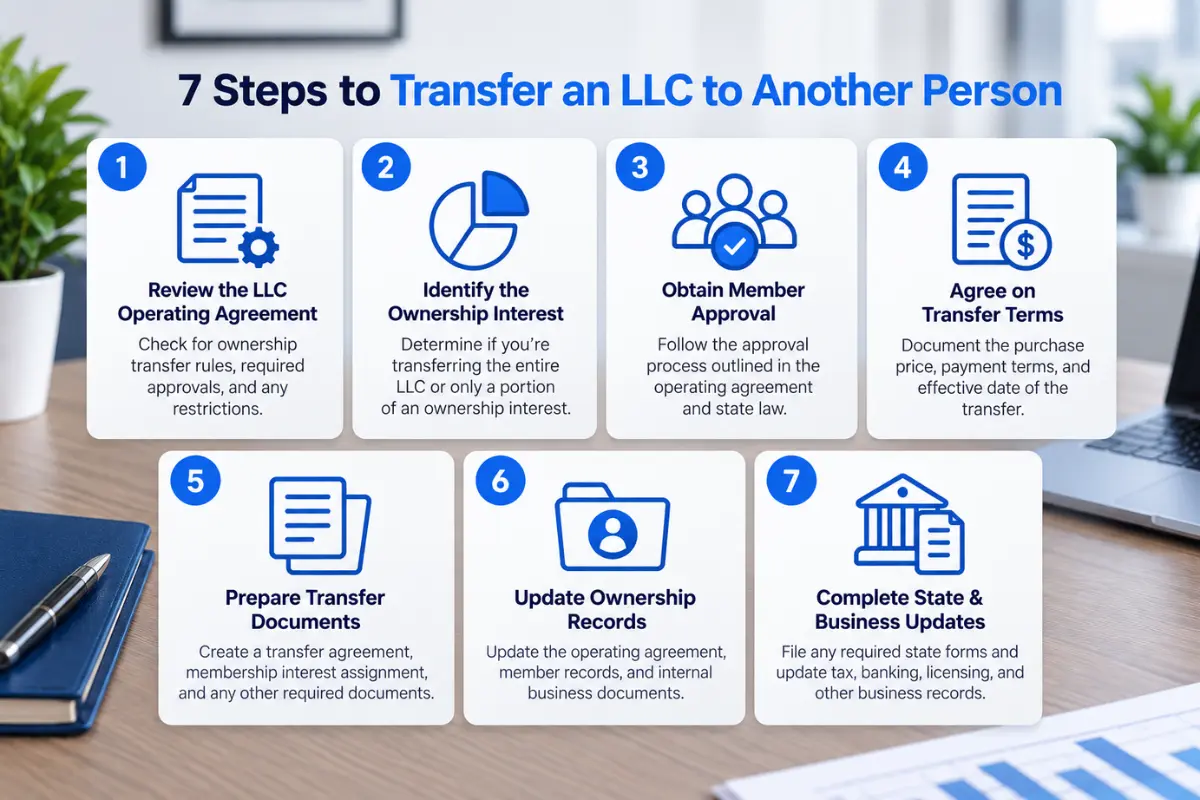
How to Transfer an LLC to Another Person: 7 Steps
Here’s how to transfer an LLC to another person. The LLC ownership transfer process varies based on state laws, the LLC operating agreement, the ownership structure, and whether you are transferring full or partial ownership of a limited liability company.
Step 1: Review the LLC Operating Agreement
The LLC operating agreement sets the rules for transferring LLC ownership and handling ownership changes. According to the U.S. Small Business Administration, an operating agreement “describes the structure of your company’s financial and functional decisions.”
Review the operating agreement for ownership-transfer restrictions, required approval from other LLC members, rights of first refusal, buy-sell provisions, valuation requirements, and procedures for admitting a new member or handling an LLC member who dies.
If your LLC has no operating agreement, or if its agreement does not address ownership transfers, applicable state default rules may govern the transfer process. This can be a good time to create or update an operating agreement.
Step 2: Identify the Ownership Interest Being Transferred
Determine whether the LLC transfer involves all ownership interests in a single-member LLC, one member’s full interest in a multi-member LLC, or only a portion of an LLC membership interest.
A partial transfer can involve economic rights, voting rights, management rights, or all three. In a multi-member LLC, a person receiving only economic rights may not automatically become a new LLC member with management or voting authority. The remaining LLC members may need to approve the new ownership structure.
Step 3: Obtain Approval From LLC Members
Multi-member LLCs commonly require approval before transferring ownership or admitting a new member. Follow the voting rules in the LLC operating agreement and document approval with written consent, a member resolution, or meeting minutes.
This step helps the parties involved avoid legal complications and confirms that the transfer of ownership complies with the LLC’s governing documents. For more information, see our guide to adding a member to an LLC.
Step 4: Agree on the Transfer Terms
Before finalizing an LLC ownership transfer, the current owner and new owner should agree on the transfer terms, including:
- The ownership stake or ownership percentage being transferred
- The selling price, gift terms, or other consideration
- Payment terms and the effective date
- Voting and management rights
- Assets, liabilities, and conditions included in the transaction
- Tax implications and other tax consequences
Use the valuation method in any buy-sell agreement or buy-sell provisions. Depending on the business, market value, book value, or a professional appraisal may help establish a fair price when selling ownership interests.
Step 5: Prepare the LLC Transfer Documents
Put the LLC ownership transfer in writing. The legal documents may include a membership-interest purchase agreement, assignment of LLC membership interest, written member consent, an ownership transfer agreement, and an amended operating agreement.
A template may help with a simple transfer, but it may not address the LLC’s operating agreement, state laws, legal requirements, tax implications, or the specific parties involved. Consider consulting legal counsel, a business attorney, legal advisor, or tax professional before completing a complex ownership transfer.
Step 6: Update Ownership Records
After closing, update the LLC’s internal ownership records, including its operating agreement, membership ledger, ownership percentage, capital accounts, voting rights, management authority, and member resolutions.
These records should identify the effective date of the ownership transfer, the former owner, the new owner, and the LLC’s new ownership structure. Learn more in our guide on how to create an operating agreement.
Step 7: Complete State and Business Updates
Changing ownership of an LLC may require updates with the secretary of state, state tax agencies, the Internal Revenue Service, financial institutions, licensing agencies, insurance providers, vendors, contract partners, the registered agent, and other business contacts.
The U.S. Small Business Administration notes that state registration requirements vary and can include a company’s ownership and management structure. Some states require Articles of Amendment, and our LLC amendment filing service can handle that for you.
Ask your bank and other financial institutions whether authorized signers, account access, lending documents, or payment authorizations need to be updated. If the LLC’s responsible party changes, file Form 8822-B with the Internal Revenue Service within 60 days.
Do You Need an LLC Transfer of Ownership Form?
There’s no single LLC transfer of ownership form that works nationwide. Depending on the deal, you may need an assignment of membership interest, a membership interest purchase agreement, written member consent, an amended operating agreement, Articles of Amendment, or an annual or periodic report.
Here’s the key distinction. Internal documents legally record the ownership deal, while state filings update government records. A state form doesn’t replace documenting the transfer itself.
What Should an LLC Transfer Agreement Include?
An LLC transfer agreement typically covers the LLC’s legal name, the current and new owners, the membership interest and ownership percentage, the price and payment terms, and the effective date. It should also address voting and management rights, representations and warranties, required member approvals, and signatures.
A template may be a useful start, but it won’t cover every state, legal, tax, or business-specific issue.
How to Transfer a Single-Member LLC to Another Person
To give someone complete ownership of a single-member LLC, you generally transfer your entire membership interest. That means reviewing the operating agreement, documenting the transfer, setting an effective date, and updating the operating agreement and company records.
You’ll also change authorized signers, check for state filings, and review tax classification and EIN requirements. Transferring the LLC differs from an asset sale, where a buyer purchases specific items and the legal entity stays with the seller.
How to Transfer Ownership in a Multi-Member LLC
Multi-member LLCs involve more steps because other members have a say. You’ll work through operating agreement restrictions, member approvals, rights of first refusal, and buy-sell provisions.
You’ll also sort out economic rights vs. full membership rights, voting and management rights, and new ownership percentages. Once the departing member exits and the new member is admitted, update the operating agreement. If a member is leaving without a buyer, see our guide on removing a member from an LLC.
Does Transferring an LLC to a New Owner Require a New EIN?
Not necessarily. According to the Internal Revenue Service, “You need a new EIN, in general, when you change your entity’s ownership or structure.”
However, an ownership transfer does not automatically mean an LLC needs a new EIN. The answer depends on the nature of the transfer, whether the LLC remains in existence, its federal tax classification, and whether the transaction changes the entity’s legal or tax structure. Review the IRS guidance for your circumstances and consult a qualified tax professional when appropriate.
Are There Tax Consequences When Transferring LLC Ownership?
There can be. Tax consequences may depend on the seller’s gain or loss, tax basis in the LLC interest, purchase-price allocation, partnership tax rules for multi-member LLCs, changes in tax classification, and applicable state taxes.
A sale and a gift can have different tax consequences. A seller may recognize taxable gain or loss on the sale of an LLC interest. For a gift, the federal annual gift-tax exclusion is $19,000 per recipient in 2026. Gifts above that amount may require the donor to file a federal gift-tax return, even if no gift tax is ultimately due, according to the IRS. Consult a qualified tax professional before completing the transfer.
Can You Transfer an LLC to a Family Member?
Many business owners ask, “Can I transfer my LLC to my daughter?” In many cases, yes. You may transfer all or part of an LLC ownership interest to a family member through a sale, gift, partial ownership transfer, succession plan, or estate plan.
However, a family transfer still needs to follow the LLC’s operating agreement, any required member-approval process, and applicable state law. A gift may also have different tax consequences than a sale.
Common Mistakes When Transferring LLC Ownership
Watch for these common mistakes:
- Overlooking the operating agreement or ignoring transfer restrictions
- Failing to obtain required member approval
- Assuming a state filing alone completes the ownership transfer
- Using an incomplete or unclear transfer agreement
- Failing to establish an effective date for the transfer
- Not updating the operating agreement and company records
- Missing required state filings or notifications
- Overlooking EIN and tax considerations
- Failing to update bank-account signers and financial authorizations
- Forgetting to review business licenses, permits, contracts, and insurance policies
A smooth transfer addresses both the legal ownership transaction and the administrative updates that may follow.
How Long Does It Take to Transfer an LLC to Another Person?
There is no universal timeline for transferring LLC ownership. The process may depend on the operating agreement, required member approvals, negotiations, document preparation, the ownership structure, state filing requirements and processing times, and any legal or tax review.
The effective date of the ownership transfer may be different from the date a state processes a related filing. In other words, the parties may complete the transfer under their agreement before the state updates its records, where an update is required.
Conclusion: Transferring Your LLC to a New Owner
Transferring an LLC to a new owner generally involves these seven steps:
- Review the operating agreement.
- Identify the ownership interest being transferred.
- Obtain any required approvals.
- Agree on the transfer terms.
- Document the transaction.
- Update the LLC’s internal records.
- Complete any applicable government, tax, financial, licensing, contract, and insurance updates.
An LLC ownership transfer involves more than changing a name on a government filing. Clear transfer documents, accurate company records, and timely administrative updates can help create an orderly transition for the LLC and its new owner.
Need Help Updating Your LLC After an Ownership Change?
An ownership change often means your governing documents need a refresh. Our operating agreement service helps your records reflect your new ownership. Questions about what comes next? Contact Us and our team will point you in the right direction.
FAQs About Transferring an LLC to Another Person
Can you transfer an LLC to another person?
Yes. An LLC ownership interest can generally be transferred through a sale, gift, or assignment. The process depends on your operating agreement, state law, and ownership structure. It also depends on whether you're transferring all of your ownership or only part of it.
How do I transfer an LLC to another person?
Review the operating agreement, decide what's being transferred, and get approval. Then agree on terms, prepare transfer documents, update internal records, and complete state, tax, and business updates.
Can I transfer my LLC to another person without selling it?
Yes, such as through a gift. You still need to follow the operating agreement and state requirements and consider tax consequences.
Do I need an LLC transfer of ownership form?
There isn't one nationwide form. The documents you need depend on the transaction, operating agreement, LLC structure, and state.
Can I transfer my LLC to a family member?
Yes. You can generally sell or gift LLC ownership to family, subject to transfer restrictions, member approval, state law, and possible tax implications.
Does the new LLC owner need a new EIN?
It depends on the LLC's structure, tax classification, and type of ownership change. Check the IRS's current guidance on when to get a new EIN.
Do I need a lawyer to transfer LLC ownership?
Not always. A business attorney may be wise for large sales, multi-member companies, complicated operating agreements, disputes, or deals with major legal or tax consequences.

Disclaimer: This content is intended for general educational and informational purposes only and does not constitute legal, tax, or accounting advice. Every effort is made to keep the information current and accurate; however, laws, regulations, and guidance can change, and no representation or warranty is given that the content is complete, up to date, or suitable for any particular situation. You should not rely on this material as a substitute for advice from a qualified professional who can consider your specific facts and objectives before you make decisions or take action.