

Operating Agreement: What Every LLC Owner Should Know
What happens to your LLC the day two members stop agreeing? Without something in writing, the answer is whatever your state’s default rules say, not what you and your business partners actually intended. That is the gap an operating agreement is built to close.
Forming an LLC protects your personal assets, but the paperwork does not stop once your business is registered. One of the most important documents you will create after formation is your operating agreement, the internal document that spells out who owns what, how decisions get made, and how the company runs when things get complicated.
Even if your state does not require one, skipping this step can leave your business without a clear rulebook when disagreements or ownership changes come up. DoMyLLC helps new business owners put this foundational piece in place, so a company starts with clear expectations from day one. Understanding what an operating agreement is and why it matters can save you time, money, and stress down the road.
Key Takeaways
- An operating agreement outlines your LLC’s ownership, management, and operating procedures.
- Every LLC should have an operating agreement, even if state law does not require one.
- A written agreement helps protect limited liability protection and reduces the risk of member disputes.
- Banks, investors, and future business partners may request an operating agreement.
- A professionally prepared, state specific operating agreement helps your business start with a solid legal foundation.
What Is an Operating Agreement?
An operating agreement is a legal document that spells out how your limited liability company runs internally. Unlike your articles of organization, this is an internal document, not a public filing. You do not file it with the state, but once your members sign it, it becomes a legally binding agreement.
Think of it as your company’s internal rulebook. It covers ownership, or how much of the business each member owns, along with the management structure, voting rights, financial decisions, and each member’s responsibilities. It also outlines profit distribution and how the LLC’s members plan to handle the day to day running of the company.
According to the U.S. Small Business Administration, an LLC operating agreement describes the structure of your company’s financial and functional decisions.
In short, this one document sets the tone for how your business operates internally, long before a dispute or major decision ever comes up. If you are ready to put one in place, DoMyLLC’s Operating Agreement Filing service can help you create a document built around your state and your business.
What Is an Operating Agreement for an LLC?
For an LLC specifically, the operating agreement becomes the reference point for nearly every internal decision the business makes. A solid LLC operating agreement usually addresses:
Ownership: how much of the company each member holds, often shown as an ownership percentage.
Management structure: whether the LLC is member managed or manager managed.
Voting rights: how much say each member has, and what counts as a majority or unanimous vote.
Financial responsibilities: who oversees company funds, bookkeeping, and financial records.
Dispute resolution: how disagreements between members get resolved.
Day to day operations: who handles daily tasks and management responsibilities.
Your management structure shapes much of what goes into the rest of the agreement. Member managed LLCs give all the members a direct hand in decisions, while manager managed LLCs put daily operations in the hands of one or more designated managers. If you are not sure which setup fits your business, our article on Member-Managed vs. Manager-Managed LLC breaks down the differences.
According to the Cornell Law School Legal Information Institute, although most states do not require the creation of an operating agreement, it is nonetheless regarded as a critical document that should be included when forming a limited liability company.
Operating Agreement vs. Articles of Organization
It is easy to confuse an operating agreement with articles of organization, but the two serve very different purposes.
Your articles of organization get your LLC on the books with the state. Your operating agreement decides how that LLC actually runs day to day. A new business needs both to build a solid foundation. If you have not filed your articles of organization yet, our guide on How to Start an LLC walks through the process step by step.
According to the IRS, state law governs the organization and operation of LLCs. Your operating agreement works alongside those state rules, and in many cases, a written operating agreement can override the state’s default rules with terms that fit your business.
Do LLCs Require an Operating Agreement?
Most states do not legally require an operating agreement, but a handful of states do. If your LLC is formed in one of these states, a written operating agreement is not optional.
| State | Operating Agreement Requirement |
|---|---|
| California | Requires a written operating agreement |
| New York | Requires an operating agreement within 90 days of filing |
| Missouri | Requires LLCs to adopt an operating agreement |
| Delaware | Requires a limited liability company agreement |
| Maine | Requires a limited liability company agreement |
| All other states | Not legally required, but strongly recommended |
Even where states do not require LLCs to have this document, that does not mean you should skip it. Without an operating agreement, your LLC is governed entirely by the state’s default rules, and those default rules may not match how you want your business to run. Both single member LLCs and multi member LLCs benefit from setting their own terms.
What Should an LLC Operating Agreement Include?
A complete LLC operating agreement should cover several key provisions. Here is what belongs in yours.
Ownership Information
Members: list every member’s full legal name and contact information.
Ownership percentages: show what share of the company each member owns, based on their initial capital contributions.
Management Structure
Member managed: all the members share management responsibilities and take part in daily decisions.
Manager managed: one or more designated managers handle daily operations while other members take a more passive role.
Voting Procedures
Outline how members vote on business decisions. Routine matters may require only a simple majority, while major decisions such as admitting new members or dissolving the company may require unanimous consent.
Profit and Loss Distribution
Decide how profits and losses get divided among members. Many LLCs base profit distribution on ownership percentage, but your agreement can set custom terms as long as all the members agree.
Capital Contributions
Document each member’s initial contribution, whether cash, property, or services, along with any rules for future contributions used to cover company funds and expenses.
Buyout & Transfer Provisions
Outline what happens when a member wants to sell an ownership interest, leaves the business, or passes away. Clear rules for transferring interests protect the other members and keep new members from joining without everyone’s agreement.
Dissolution Procedures
Include steps for closing the business if the members decide to dissolve the LLC, covering how remaining company funds and assets get distributed once debts are paid.
How to Create an Operating Agreement
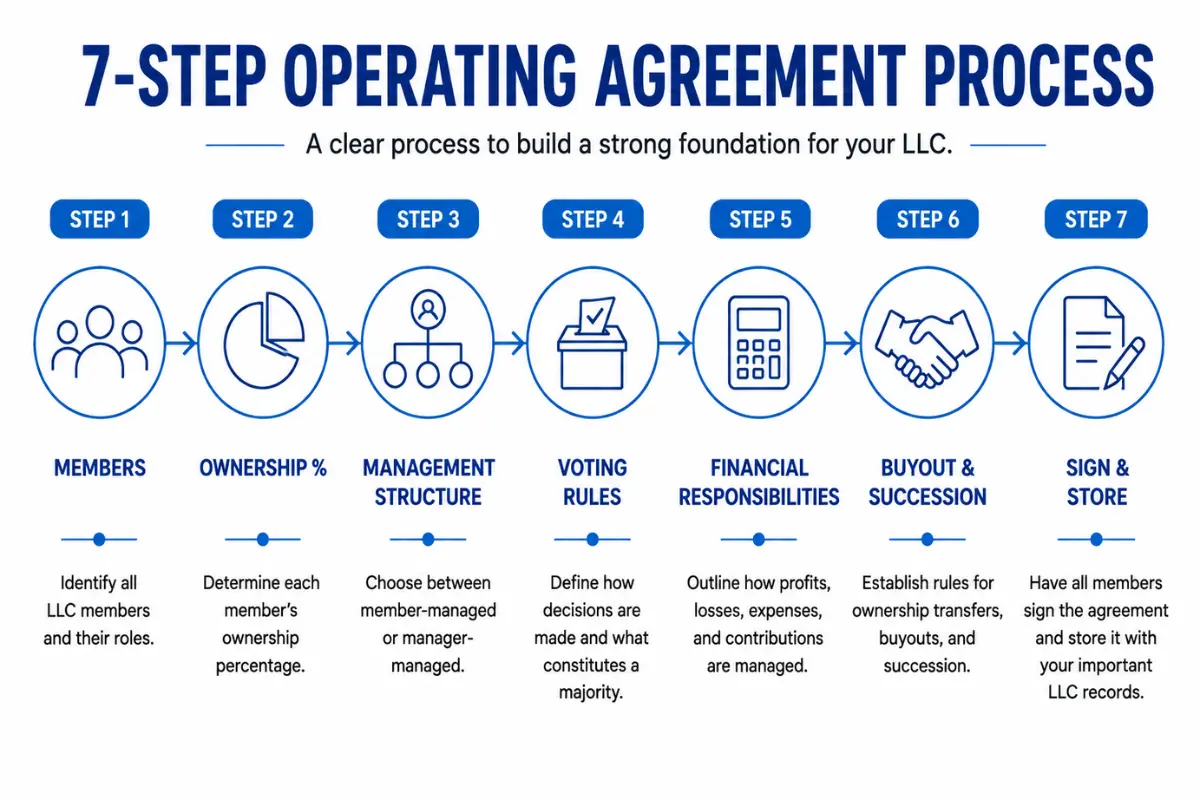
Creating an operating agreement does not have to be complicated once you know what to include. Here is how to build one, step by step.
Step 1: Identify LLC Members
List every person or entity with an ownership interest in the company, including full names and contact details.
Step 2: Determine Ownership Percentages
Decide how much of the company each member owns, based on initial contribution, effort, or agreement among members.
Step 3: Choose the Management Structure
Decide whether your LLC will be member managed or manager managed, and outline the management responsibilities that come with that choice.
Step 4: Establish Voting Procedures
Set clear rules for how decisions get made, including what requires a simple majority versus unanimous consent.
Step 5: Outline Financial Responsibilities
Detail how profits and losses are distributed, who manages company funds, and how financial records are maintained.
Step 6: Include Buyout and Succession Provisions
Plan ahead for ownership changes, whether a member wants to leave, sell an ownership interest, or pass it along to someone else.
Step 7: Review, Sign, and Safely Store the Agreement
Have all the members sign the finished document, then keep a copy in a safe, accessible place along with your other financial records and business documents.
Yes, you can write your own operating agreement. Plenty of business owners do, especially in the early days of a new business. But every LLC is different, and state specific laws affect what your agreement should include. A generic template pulled from the internet may miss requirements specific to your state or leave gaps that cause problems later. A professionally prepared agreement helps you avoid common mistakes and makes sure nothing important gets left out.
How Much Does an LLC Operating Agreement Cost?
The cost of an LLC operating agreement depends on how you create it. Here is a general comparison of the options.
| Method | Typical Cost | What You Get |
|---|---|---|
| DIY or free templates | $0 | Generic terms, no state specific guidance, higher risk of gaps |
| Online legal document services | $50 to $200 | Basic customization, limited state specific support |
| Attorney drafted agreement | $500 to $2,000+ | Fully customized, state specific document with legal review |
| DoMyLLC sample template | Free with formation pack | Included with every client’s final formation pack as a starting point |
| DoMyLLC filled-in agreement | $99 | DoMyLLC completes the document for you based on your ownership and management details |
Price matters, but the real question is value. A free template pulled from the internet that misses your state’s requirements can cost far more down the road if it fails to protect your personal liability or leads to disputes among members. DoMyLLC’s free sample template comes with your final formation pack, giving you a reliable starting point instead of a generic download.
Common Mistakes to Avoid
Even well-intentioned business owners can run into problems with their operating agreement. To avoid issues down the road, be sure not to:
- skip creating an operating agreement altogether.
- use a generic template that does not follow state law.
- fail to update the agreement as the business changes.
- leave out member signatures.
- make voting procedures unclear.
- overlook an exit strategy.
- omit buyout provisions.
Do Single-Member LLCs Need an Operating Agreement?
If you are the only owner of your LLC, you might assume an operating agreement is unnecessary. In reality, single member LLCs benefit from having one just as much as multi member LLCs do.
- Reinforces limited liability protection by showing your business operates as a separate legal entity.
- Helps separate personal assets from company funds.
- Makes it easier to open a business bank account.
- Simplifies future ownership changes if you bring on new members.
- Adds professionalism when working with banks, investors, or partners.
Whether you are running a single member LLC now or planning to bring on partners later, understanding the differences matters. Check out our comparison of Single-Member LLC vs. Multi-Member LLC for more.
Conclusion
Every LLC should have an operating agreement, whether state law requires one or not. It defines your ownership, management, and financial responsibilities, and it reinforces the personal liability protection your LLC is meant to provide. Even when it is not a legal requirement, having one in place strengthens your business and helps prevent disputes down the road.
Starting your business with the right documents in place makes it easier to grow with confidence.
How DoMyLLC Supports Your LLC
From formation and registered agent service to annual report filings and EIN applications, We support your LLC every step of the way so you can focus on running your business.
Curious whether forming an LLC fits your goals? Take a look at Is an LLC Worth It?, or Contact Us to get started on everything your business needs, today.
Operating Agreement FAQs
It is an internal legal document that outlines how a limited liability company is owned, managed, and operated. It covers ownership percentages, management structure, voting rights, and profit distribution among members.
Most states do not require LLCs to have one, but California, New York, Missouri, Delaware, and Maine do. Even where it is not a legal requirement, every LLC benefits from having a written operating agreement.
Yes, you can write your own operating agreement. However, since state specific rules apply, a professionally prepared, state specific document helps make sure nothing important gets left out.
Costs range from free templates to attorney drafted documents costing $500 or more. We include a free sample operating agreement with every client's final formation pack, and for $99, We will fill in the document for you.
Yes. Even with one owner, an operating agreement reinforces limited liability protection, helps separate personal assets from company funds, and adds professionalism when working with banks or investors.
No. Unlike articles of organization, an operating agreement is an internal document. It is not filed with the state, but it is still a legally binding agreement between members once signed.
Yes. Most operating agreements include an amendment process. Members typically need unanimous consent or a majority vote, depending on what the original agreement specifies, to make changes.
All the members of the LLC should sign the operating agreement, including in single member LLCs. Signatures make the document a binding legal contract among the members.
Without one, your LLC is governed by the state's default rules, which may not reflect how you actually want your business to run. This can lead to disputes among members and weaker protection for your personal liability.
Disclaimer: This content is intended for general educational and informational purposes only and does not constitute legal, tax, or accounting advice. Every effort is made to keep the information current and accurate; however, laws, regulations, and guidance can change, and no representation or warranty is given that the content is complete, up to date, or suitable for any particular situation. You should not rely on this material as a substitute for advice from a qualified professional who can consider your specific facts and objectives before you make decisions or take action.