

How to Remove a Member From an LLC: Step-by-Step Guide
What happens when a business partner stops pulling their weight, or worse, starts pulling in the wrong direction? For a lot of LLC owners, that question isn’t hypothetical. A member misses deadlines, disappears from decisions, or breaches the trust the whole company was built on, and suddenly everyone is asking the same thing: can we remove a member from an LLC?
Removing a member is an ownership change that can touch your operating agreement, state law, finances, and records, and voluntary withdrawal follows a different path than involuntary removal. This DoMyLLC guide breaks down what to expect at each step.

Key Takeaways
- An LLC member may leave voluntarily or be removed under the operating agreement and applicable state law.
- The operating agreement is the first place to review for withdrawal, removal, voting, and buyout provisions.
- Removing a member may require updating ownership records, state filings, and tax information.
- A member’s departure does not automatically mean the LLC must dissolve.
- Disputed removals and complex ownership changes may require legal or tax assistance.
Can You Remove a Member From an LLC?
Yes, in most cases, but how you do it depends on your operating agreement and your LLC’s home state law. Some agreements spell out a clear removal process; others say very little, turning a simple ownership change into a significant conundrum.
There’s an important difference between voluntary withdrawal, when a member chooses to leave, and involuntary removal, when the other members decide someone needs to go, each with its own notice and documentation requirements.
It also helps to separate management authority from ownership. Taking away a member’s ability to manage the company isn’t the same as removing their ownership interest, which may still need to be purchased, transferred, or otherwise addressed.
For a closer look at management roles, this guide on member managed vs manager managed LLCs breaks down the differences.
How to Remove a Member From an LLC
Removing a member usually follows a series of steps, though the details shift depending on your operating agreement, your state, and whether the removal is voluntary or contested.
Step 1: Review the LLC Operating Agreement
Start with your written operating agreement and look for language on withdrawal, expulsion, voting, transfers, and buyouts, along with required notice periods.
If your agreement is silent on removal, state law fills the gap. As the U.S. Small Business Administration explains, operating agreements may include “Buyout and buy-sell rules (procedures for transferring interest or in the event of a death).” If you haven’t put one together yet, this guide on how to create an operating agreement can help, and this overview of what an operating agreement covers explains why it matters.
Step 2: Determine Whether the Removal Is Voluntary or Involuntary
A voluntary withdrawal usually moves faster than an involuntary removal, which may call for specific grounds and a formal vote. This affects the notice, consent, and paperwork you’ll need.
Step 3: Obtain Required Approval
Check the voting requirements in your operating agreement and state law. Some LLCs allow removal by majority vote, others require a unanimous vote. Document the decision in writing, and don’t assume a majority vote is automatically enough.
Step 4: Address the Member’s Ownership Interest
Removing someone’s management authority doesn’t remove their ownership interest, which must be addressed even if management rights end right away. Decide whether the departing member will sell, transfer, or otherwise dispose of their interest, and review any valuation and buyout provisions already in the agreement.
If none exist, the remaining members may need to negotiate a value. According to the American Bar Association, “The price to be paid for a withdrawing member’s interest can be specified in the operating agreement.” Both parties should sign a formal separation agreement if a buyout is involved. This guide on how to change the owner of an LLC covers the ownership side.
Step 5: Prepare and Sign the Necessary Documents
Once everyone agrees on terms, put it in writing: a membership transfer or buyout agreement, plus an amended operating agreement reflecting the remaining members’ updated ownership.
Step 6: Update State and Business Records
You may need to file an amendment with the Secretary of State or update your annual report; requirements vary by state. Update your membership list and review bank access and contracts tied to the departing member. Securing company assets after removal is one important reason this step shouldn’t be skipped.
Step 7: Review Tax and IRS Requirements
A membership change can affect your LLC’s federal tax classification, especially between multi member and single member status. An EIN change isn’t automatic just because a member leaves, so tax guidance pays off here.
How to Voluntarily Remove a Member From an LLC
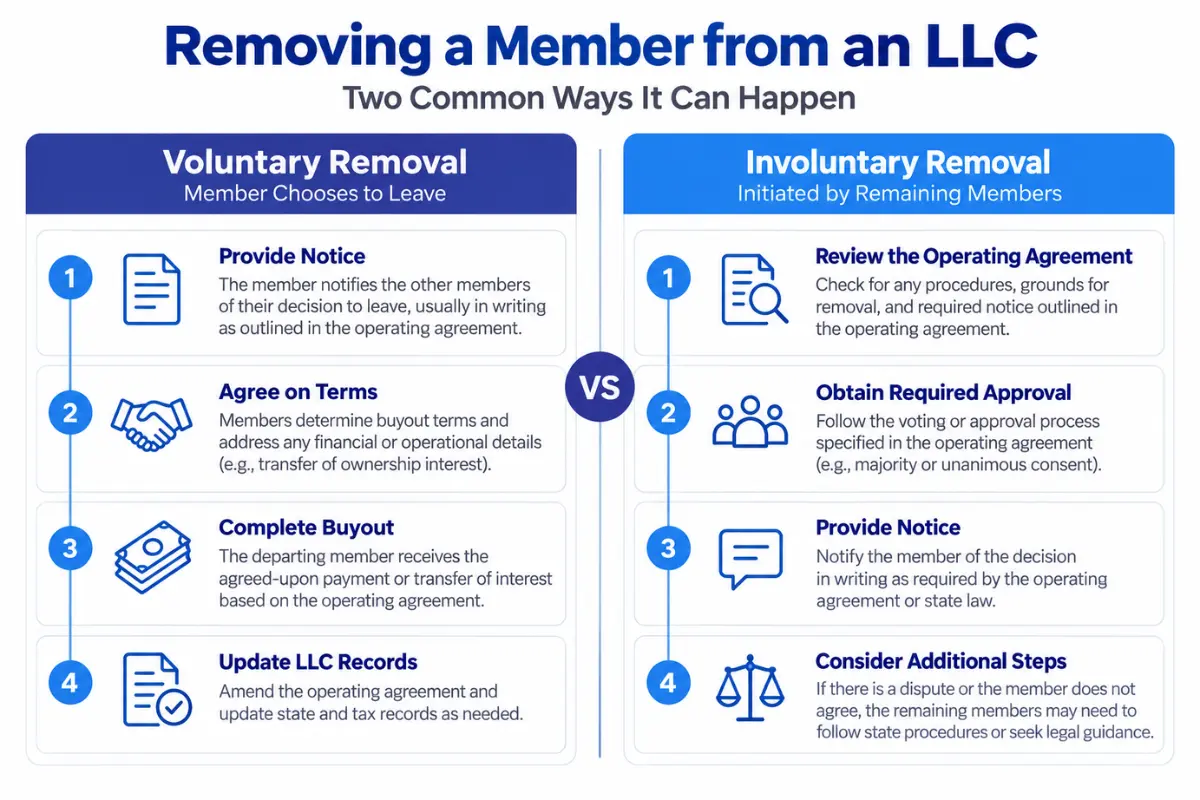
Voluntary removal happens when a member and the remaining owners agree it’s time. Review the notice requirements in your operating agreement, work out any buyout arrangements, and document the departure in writing.
How to Remove Someone From an LLC Involuntarily
Involuntary removal is more complicated because it usually requires cause, not just a change of heart. Review your operating agreement and state law first, since a fellow LLC member may only be removed for specific lawful reasons laid out in one of those two places.
Possible grounds often include serious misconduct or breach of the agreement, though these vary by state, so don’t assume they apply to your situation. It can require evidence of misconduct and, in some jurisdictions, a court process, which is why legal guidance, whether from a Texas business lawyer or an attorney in your own state, is worth seeking before a contested removal.
How to Remove Yourself From an LLC
If you’re the one leaving, start with your operating agreement’s withdrawal provisions and give written notice when required. Resolve your ownership and financial obligations, complete any transfer documents, and confirm your records reflect the departure.
If you’re transferring your interest rather than simply withdrawing, this guide on transferring ownership of an LLC walks through the process.
Sample Letter to Remove a Member From an LLC
A written notice can make a voluntary withdrawal or agreed upon removal clearer for everyone involved. A simple letter usually includes:
- The LLC’s name and the date
- The departing member’s name
- A statement of withdrawal or agreed removal
- The effective date of the change
- A reference to the operating agreement or other agreement between members
- Signature lines and acknowledgment from the relevant parties
A sample letter alone won’t complete the legal removal process; you’ll still need to update the operating agreement, ownership records, and any required state filings.
How to Remove a Member From an LLC With the IRS
The IRS doesn’t act as the authority that removes members from an LLC; that’s governed by your operating agreement and state law. What the IRS cares about is how the change affects your federal tax classification.
According to the IRS, “Changes in responsible parties must be reported to the IRS within 60 days.” An EIN change isn’t automatic, and whether you need a new one is worth reviewing with a tax professional.
Does an LLC Dissolve If a Member Leaves?
A member’s departure doesn’t automatically dissolve every LLC. Whether the business continues comes down to the operating agreement and state law, and in many cases, remaining members simply continue operating, sometimes after amending the agreement to reflect the new ownership.
Certain events, like a member’s death, bankruptcy, or a court order, can trigger dissociation and lead to voluntary or involuntary dissolution. Texas LLC law generally requires a majority vote for voluntary dissolution and a court order for involuntary dissolution, while Washington law allows a member to withdraw at any time, showing why it pays to check your home state’s law.
Common Mistakes to Avoid When Removing an LLC Member
- Failing to review the operating agreement before taking any action
- Assuming a member can always be removed by a simple majority vote
- Overlooking buyout or ownership transfer requirements
- Failing to document the removal decision in writing
- Forgetting to update state filings, banking access, or tax records
- Treating a member’s departure as an automatic dissolution of the LLC
Conclusion
Removing a member from an LLC touches your operating agreement, state law, finances, and business records all at once, so it pays to follow the process carefully and lean on professional guidance when the removal is disputed or the tax implications are significant.
Get Help Managing LLC Ownership Changes
Navigating state filing requirements after an ownership change can eat up time you’d rather spend running your company. DoMyLLC helps business owners handle the paperwork, from updating business records to keeping the LLC in good standing after a member leaves. Our filing assistance doesn’t replace legal advice for disputed removals or tax advice for complex transactions, so we always recommend an attorney or tax professional for those situations.
Contact Us to learn how we can support your LLC through an ownership change.
Remove Member from LLC FAQs
It depends on the operating agreement, your state's laws, and the circumstances. Some agreements allow involuntary removal under certain conditions, while others require consent.
Yes, generally, following whatever the operating agreement requires. In states like Texas, voluntary withdrawal without an agreement in place isn't permitted.
Filing requirements vary by state and by the type of ownership change, from an amendment to your formation documents to an update on your next annual report.
Not automatically. It depends on whether the LLC's tax classification shifts as a result of the change.
In most cases, yes, subject to the operating agreement and applicable state law.
It's usually addressed through a buyout, a transfer to another member, or another arrangement in the operating agreement.
Timing depends on the agreement's requirements, the approvals needed, and how quickly your state processes any required filings.
Disclaimer: This content is intended for general educational and informational purposes only and does not constitute legal, tax, or accounting advice. Every effort is made to keep the information current and accurate; however, laws, regulations, and guidance can change, and no representation or warranty is given that the content is complete, up to date, or suitable for any particular situation. You should not rely on this material as a substitute for advice from a qualified professional who can consider your specific facts and objectives before you make decisions or take action.