

Can an LLC Have Multiple Owners? A Guide to Multi-Member LLCs
You and a friend just shook hands on a business idea, and the excitement is starting to turn into questions. Can an LLC have multiple owners, or do you need a different structure entirely? The short answer is yes. When two or more people, or even other businesses, own an LLC together, it is called a multi-member LLC.
Whether you are starting a business with a partner, adding a co-owner to an existing single-member LLC, or comparing this structure to a general partnership, DoMyLLC can help you understand how ownership, taxes, and management work before you file.
This guide walks through what a multi-member LLC is, how ownership gets divided, and what to expect when it comes to taxes and management responsibilities.

Key Takeaways
- Multiple owners are allowed. An LLC can have two or more members, and ownership does not need to be split equally.
- Ownership should be documented. An operating agreement can spell out ownership percentages, management roles, voting rights, and how profits get divided.
- Tax treatment matters. A domestic multi-member LLC is generally taxed as a partnership by default, though other elections are available.
- Management can be flexible. Members can run the business themselves or appoint managers, depending on state law and how the LLC is set up.
- Planning prevents disputes. Clear agreements about contributions, decisions, and member exits make co-ownership much easier down the road.
What Is a Multi-Member LLC?
A multi-member LLC is simply a limited liability company with two or more owners, known as members. This sets it apart from a single-member LLC, which has just one owner and is typically treated as a disregarded entity for federal income tax purposes.
Members of an LLC do not have to be individuals. According to the IRS, owners of an LLC are called members. Because most states do not restrict who can join an LLC, members can be individuals, corporations, or even other LLCs, including certain foreign entities.
Say two friends decide to open a coffee shop together. If they form an LLC and both sign on as owners, they are now members of a multi-member LLC. Each one shares in the liability protection the business entity provides, along with a say in how it runs. If you are trying to decide whether one owner or multiple owners makes sense for your situation, this comparison of a single-member LLC vs. multi-member LLC breaks down the differences in more detail.
How Many Owners Can an LLC Have?
Most states place no fixed maximum on how many members an LLC can have. Whether you are forming an LLC with one business partner, two, or a dozen, the structure can typically accommodate it. As the IRS explains, there is no maximum number of members.
That said, a few factors can affect ownership size in practice. If your LLC plans to elect S corporation tax status, for example, the IRS limits S corps to 100 shareholders and requires that all owners be U.S. citizens or residents. Some states also have their own filing or reporting requirements that become more involved as membership grows.
Ownership percentages do not have to be split evenly among members, either. Two owners could split ownership 50/50, or one member could hold 70 percent while the other holds 30 percent, depending on how much each person contributes in capital, time, or expertise.
How Do You Split Ownership of an LLC?
Multi-member LLCs commonly divide ownership a few different ways. Some members choose an even 50/50 split. Others negotiate percentages based on how much money, property, or work each person contributes to the business, such as a 60/40 or 70/30 arrangement.
As Cornell Law School’s Legal Information Institute explains, an LLC can be composed of members who each own and control equal parts of the business. Equal ownership is common, but it is far from required. What matters most is that the arrangement reflects what each member is actually putting into the business and that everyone agrees to it up front.
It also helps to separate ownership percentage from voting rights and profit allocation. A member who owns 30 percent of the LLC does not automatically have 30 percent of the voting power or receive exactly 30 percent of distributed profits. These details can all be set differently in the operating agreement, which is why members should document their arrangement clearly rather than assume it will follow ownership stake by default. If ownership ever needs to change down the road, understanding how to change the owner of an LLC ahead of time can save a lot of headaches.
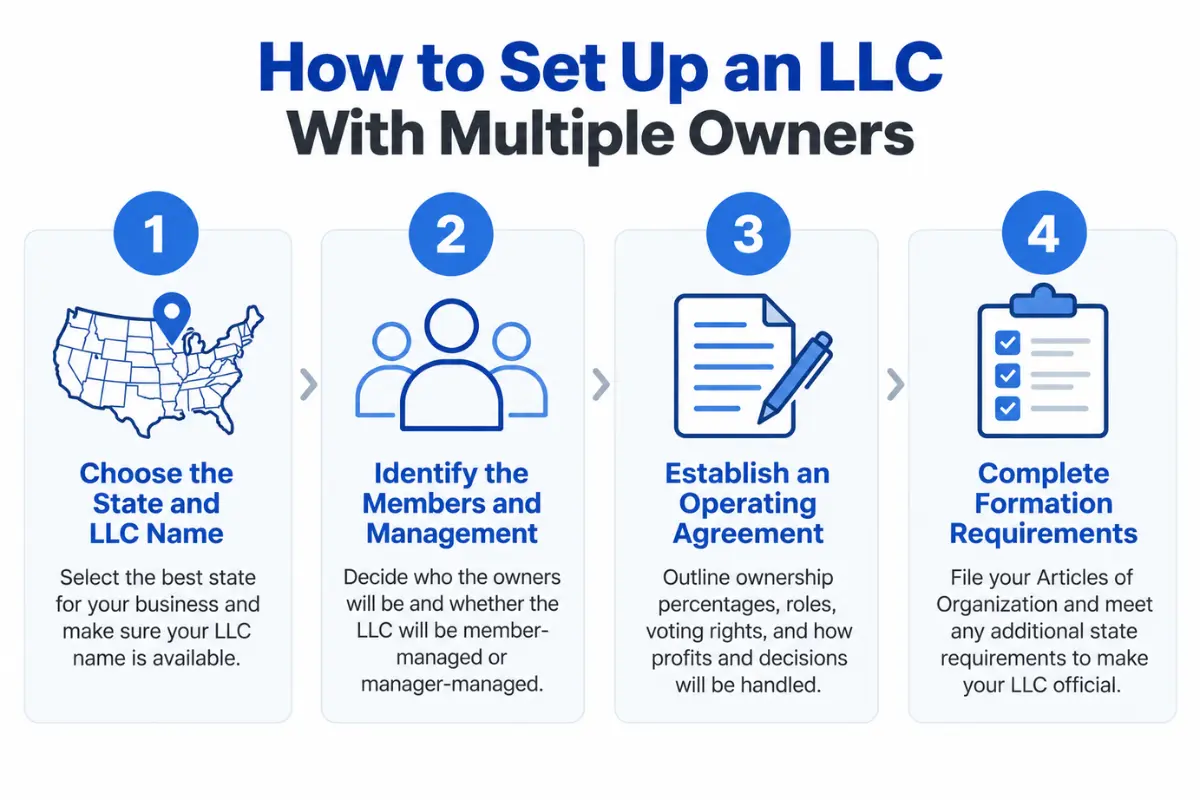
How to Set Up an LLC With Multiple Owners
Forming a multi-member LLC involves many of the same steps as starting any LLC, along with a few additional considerations for businesses with more than one owner.
Choose the State and LLC Name
Formation requirements vary from state to state, so the first step is deciding where to form your LLC. Most business owners form in the state where they operate, though this is not always required. Once you have chosen a state, you will need to confirm your desired business name is available and meets that state’s naming rules.
Identify the Members and Management Structure
Next, identify everyone who will own a piece of the business and decide how the LLC will be managed. Multi-member LLCs can be member managed, where the owners handle daily operations themselves, or manager managed, where the members appoint one or more managers, who may or may not be members, to run the business.
If you already have a single-member LLC and want to bring on a co-owner, you will need to go through the process to add a member to an LLC, which typically involves updating the operating agreement and notifying the state.
Establish an Operating Agreement
An LLC’s operating agreement is one of the most important documents for a multi-member LLC. It should spell out ownership percentages, capital contributions, voting rights, how profits and losses are distributed, and what happens if a member wants to leave or sell their interest.
With multiple owners involved, a written agreement matters even more than it does for a single-member LLC. Verbal understandings can be remembered differently by each person, and disagreements are far easier to resolve when there is a signed operating agreement everyone can refer back to.
Complete Formation and Initial Business Requirements
Once ownership and management are settled, you will file your formation documents, often called articles of organization, with the state. You will also need a registered agent, and depending on your business, you may need an EIN, business licenses, or a dedicated business bank account. Requirements vary by state and industry, so it is worth confirming what applies to your specific business before you file.
Is an LLC With 2 Owners the Same as a Partnership?
Not exactly. A multi-member LLC and a general partnership are two different legal structures, even though a two-owner LLC is often taxed the same way as a partnership by default.
The biggest difference comes down to liability. In a general partnership, each partner is typically personally liable for business debts and the actions of the other partners. In a multi-member LLC, members generally have limited liability protection, meaning their personal assets are shielded from most business debts and lawsuits.
Formation also differs. A general partnership can form automatically the moment two people start doing business together, with no state filing required. A multi-member LLC, on the other hand, requires filing articles of organization with the state and following that state’s ongoing compliance requirements.
Tax treatment is where the two structures overlap, and it is likely why people confuse them. A domestic LLC with two or more members is generally treated as a partnership for federal tax purposes by default. But sharing a tax classification does not make them the same legal entity. If you are still weighing your options, this breakdown of the best business structure for entrepreneurs can help you compare LLCs, partnerships, and other structures side by side.
Multi-Member LLC Taxes: What Owners Should Know
By default, the IRS treats a domestic LLC with two or more members as a partnership for federal tax purposes.
This means the LLC itself typically does not pay federal income tax. Instead, the business files Form 1065to report its income, and each member receives a Schedule K-1 showing their share of the LLC’s profits or losses. Members then report that income on their own personal tax returns, whether or not the profits were actually distributed to them in cash.
Members who are active in the business may also owe self employment tax on their share of the profits, since partnership income is generally subject to it. Multi-member LLCs are not locked into partnership taxation forever, either. Owners can elect to have the LLC taxed as a C corporation or, if they qualify, an S corporation instead, which can change how income and employment taxes are handled.
Because state tax rules and individual circumstances vary, it is a good idea to talk with a tax professional about which classification makes the most sense for your business.
What Are the Disadvantages of a Multi-Member LLC?
Multi-member LLCs offer plenty of advantages, but sharing ownership comes with its own set of challenges.
- Disagreements between members. More owners can mean more opinions, and disputes over spending, direction, or day to day decisions are more likely with multiple people at the table.
- More complex decision making. Decisions that one owner could make alone in a single-member LLC may require a vote or agreement among members in a multi-member LLC.
- Added tax and recordkeeping. Filing Form 1065 and issuing a Schedule K-1 to each member adds paperwork that single-member LLCs do not have to deal with.
- Complications when ownership changes. When a member wants to leave, sell their stake, or pass away, the remaining members need a clear process for handling the transition.
Without a clear process in place, transferring ownership of an LLC can become a drawn out and costly process. Most of these challenges can be managed with a solid operating agreement that spells out expectations from the start, which is exactly why that document deserves careful attention when multiple owners are involved.
Conclusion
A multi-member LLC gives entrepreneurs a flexible way to build a business with a partner, family member, or group of investors while keeping the liability protection that makes LLCs appealing in the first place. The key is setting clear expectations early, from how ownership is split to how profits are shared and how disputes get resolved.
Before you form an LLC with multiple owners, take time to think through your management structure, tax classification, and operating agreement.
How DoMyLLC Helps With Multi-Member LLC Formation
Forming a multi-member LLC involves more moving pieces than a single-member filing, and getting the details right from the start matters. Our services help entrepreneurs file the necessary paperwork accurately, so ownership and management details are documented correctly from day one.
Beyond formation, we offer registered agent services and ongoing compliance support to help multi-member LLCs keep up with state filing deadlines and requirements as the business grows. Keeping accurate records matters even more when multiple owners are involved, since each member has a stake in the business staying in good standing.
If you are ready to form an LLC with a business partner or add an owner to your existing LLC, Contact Us to get started.
Can an LLC Have Multiple Owners FAQs
Yes. An LLC with two owners is a multi-member LLC. Both owners share limited liability protection and can divide ownership, management responsibilities, and profits however they agree upon in the operating agreement.
Yes. LLCs can generally have more than two members, and most states do not set a maximum. Certain tax elections, such as S corporation status, can place limits on the number of owners, so it is worth checking those rules if you plan to elect a different tax classification.
Yes, two people can own an LLC equally, often through a 50/50 split. Equal ownership is common but not required. Members are free to divide ownership based on their contributions, roles, or whatever arrangement they agree to in the operating agreement.
No. Multi-member LLCs can be member managed, where the owners run daily operations themselves, or manager managed, where the members appoint one or more managers to handle the business. This choice depends on how involved each member wants to be and what works best for the business.
Generally, yes. A single-member LLC can add an owner, though the process depends on state law and the LLC's existing operating agreement. Adding a member typically involves updating the operating agreement, notifying the state, and reviewing how the change affects the LLC's tax classification.
Disclaimer: This content is intended for general educational and informational purposes only and does not constitute legal, tax, or accounting advice. Every effort is made to keep the information current and accurate; however, laws, regulations, and guidance can change, and no representation or warranty is given that the content is complete, up to date, or suitable for any particular situation. You should not rely on this material as a substitute for advice from a qualified professional who can consider your specific facts and objectives before you make decisions or take action.