

Best State to Form an LLC: Which State Is Right for You?
Picking a state for your LLC is not just paperwork. It is a decision that shapes what you pay in fees and taxes for as long as you own the business. Some entrepreneurs assume the best state to form an LLC is wherever the internet tells them, usually Delaware, Wyoming, or Nevada. In reality, the right state is almost always the one where the business actually operates.
DoMyLLC works with business owners every day who are weighing filing fees, annual reports, taxes, compliance rules, and privacy protections against each other. Those five factors, more than any state’s reputation, should drive the decision. This guide walks through how each one plays out so you can choose with confidence instead of guessing.
Key Takeaways
- Most small businesses should form their LLC in their home state.
- Registering in another state may require foreign qualification.
- Delaware, Wyoming, and Nevada offer advantages for certain businesses, not everyone.
- Compare long term compliance costs, not just filing fees.
- Choosing the right state now can save money later.
Does It Matter What State You Form an LLC In?
Yes, the formation state matters, but maybe not in the way you expect. It does not determine where you are allowed to operate. It determines which state’s laws govern your LLC, where you file your annual paperwork, and in some cases how much you owe in franchise taxes.
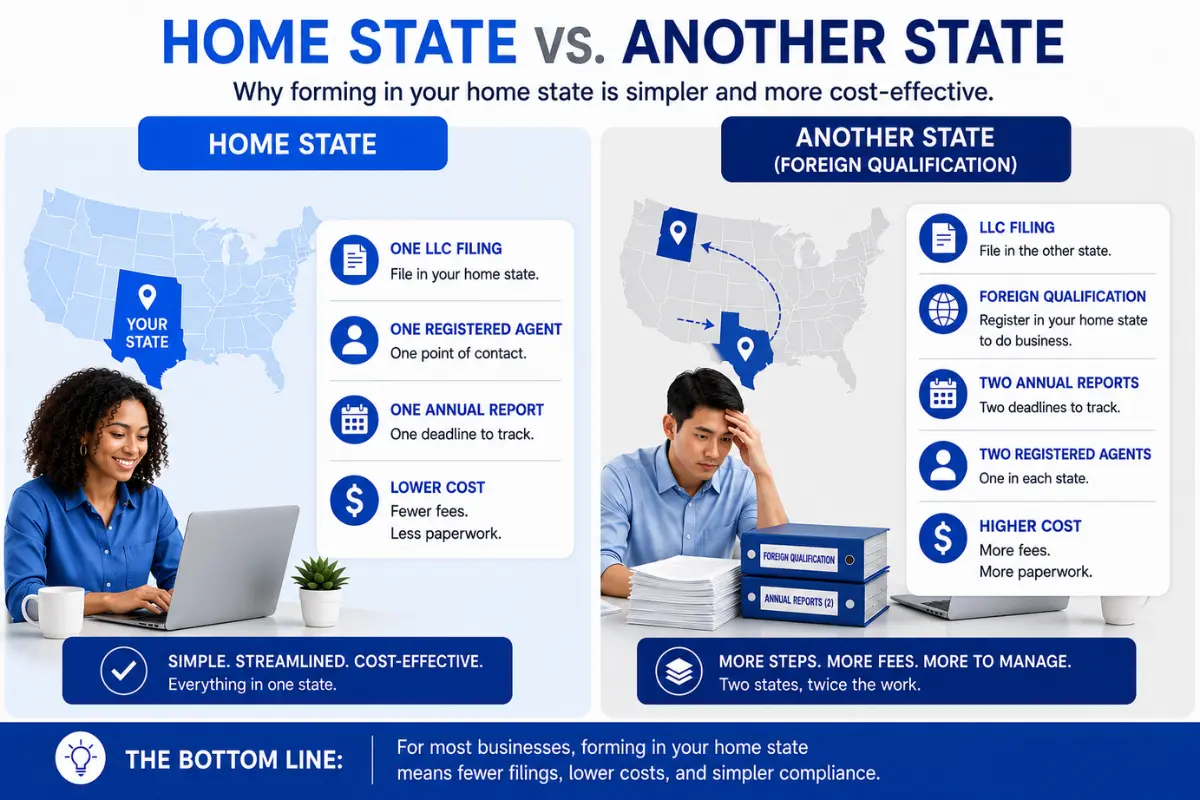
If you form your LLC in your home state, everything lines up. Your business income, your operating address, and your legal registration all sit in the same place. Form somewhere else, and you will likely need to register as a foreign entity in the state where you actually do business anyway, which means keeping up with two states instead of one.
Tax obligations follow where the business operates, not where the LLC was formed on paper. A Wyoming LLC run out of a home office in Ohio still owes Ohio taxes on the income earned there. Forming out of state does not shield you from local tax laws or state income tax.
According to the U.S. Small Business Administration, your business must be registered with the state in which it is operating. That single rule is why most business owners are better off skipping the out of state detour altogether.
Tax status works the same way no matter which state you pick. By default, an LLC is a pass through entity, meaning business income flows through to the owners personal tax returns instead of being taxed at the entity level like a C-corporation. LLC members typically pay personal income tax and self employment taxes on their share of the profits, regardless of whether the LLC was formed in a low tax state. Where the formation state actually changes your tax bill is on things like franchise taxes, state corporate income tax, and annual fees, which is why it pays to look past headlines about “no income tax” states before assuming you will save money.
Why Your Home State Is Usually the Best State to Form an LLC
For local businesses, roughly 95 percent of small businesses should form in their home state. A landscaper in Phoenix, a bakery in Columbus, or a marketing consultant in Denver gains nothing by forming an LLC in Delaware. They still need to register to transact business where their customers actually are.
Filing in another state means paying to form the LLC there, then paying again to foreign qualify in your home state. That is double the filing fees, double the annual report fees, and double the paperwork to track. Most owners find that expense hard to justify once they add it up.
Forming in your home state also keeps compliance simple. You have one registered agent, one annual report deadline, and one set of state rules to follow instead of two. Once your formation documents are filed, DoMyLLC’s guide on how long it takes to form an LLC walks through what happens after you submit your Articles of Organization and how soon you can expect state approval.
There is also the sales tax question. A domestic LLC operating in its home state deals with one set of sales tax registration and collection rules. A business that forms out of state but sells to customers locally often still has to register for sales tax in the state where the sale happens, on top of whatever compliance the formation state requires. For most small business owners, keeping filings, taxes, and a registered agent service in a single state is simply less to manage. Sales tax rules get technical fast, so it is worth checking with a CPA or tax professional on how registration and collection apply to your specific business.
When Your Home State Is the Right Choice
- Contractors working job sites in their home state
- Retail stores with a physical storefront
- Restaurants serving a local customer base
- Freelancers working with local or regional clients
- Local service businesses like salons, cleaning companies, or repair shops
These businesses have a clear physical presence in one state, so forming anywhere else just adds cost without adding benefit.
Best States to Form an LLC Compared
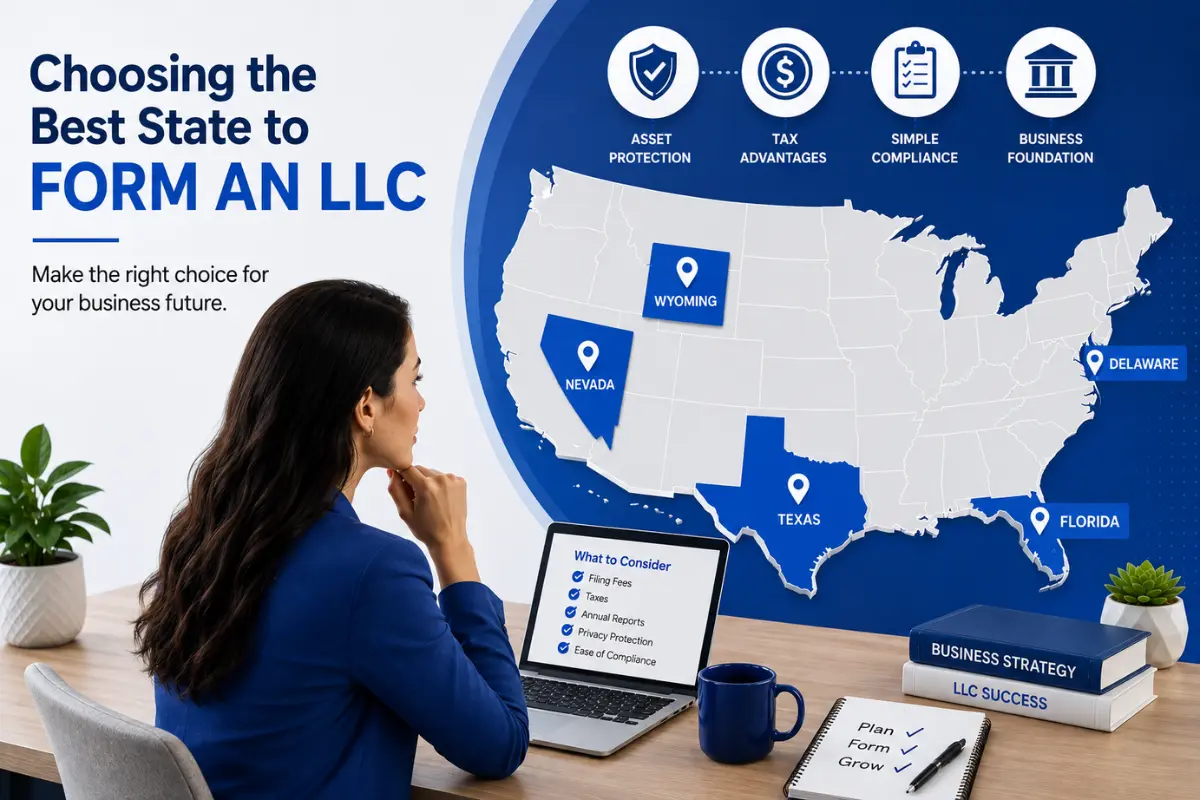
Some businesses do have good reasons to look outside their home state. Delaware, Wyoming, Nevada, Texas, and Florida each have different tax structures, filing fees, and privacy protections worth understanding before you decide. States like Wyoming, Nevada, and South Dakota also rank high on most business friendly state lists because they combine low annual fees with no state income tax.
| State | Filing Fee | Annual Fee / Tax | State Income Tax | Best For |
|---|---|---|---|---|
| Delaware | $110 | $400 flat franchise tax | None for out-of-state LLC activity | Startups raising venture capital |
| Wyoming | ~$100 | $60+ annual license tax (minimum $60) | None | Privacy + low ongoing cost |
| Nevada | $425 | $350 annual (list + business license) | None | No state income tax (higher fees) |
| Texas | $300 | $0 annual report fee (franchise report still required) | No personal income tax; franchise tax may apply | Businesses operating in Texas |
| Florida | $125 | $138.75 annual report | No personal income tax | Businesses operating in Florida |
Delaware
Delaware charges a $300 annual franchise tax for LLCs and has no state corporate income tax for LLCs that operate outside the state. It is best known for its business friendly laws and its Court of Chancery, a specialized business court that handles corporate disputes without a jury. That predictability is one reason Delaware is preferred for startups planning to raise venture capital.
According to the Delaware Division of Corporations, more than 2.2 million business entities have their legal home in Delaware. That scale reflects how many corporations, not necessarily small local LLCs, choose the state for its corporate law framework.
Wyoming
Wyoming has a $100 initial filing fee and a $60 annual renewal fee, making it one of the cheaper states to maintain an LLC. Wyoming also has no personal or corporate state income taxes, and it allows anonymous LLC ownership through trusts or nominee structures, so member names are not required on public filings.
Nevada
Nevada’s initial filing fee is $425, with roughly $350 in ongoing annual fees. In exchange, Nevada offers no state corporate income tax or personal income tax, and it does not require disclosure of LLC members in public filings. That combination of tax treatment and privacy appeals to certain business types, though the higher fees can offset the savings for smaller operations.
Texas
Texas has no personal state income tax for LLCs, and it is a genuinely business friendly state for companies that already operate there. The filing fees and franchise tax structure are moderate compared to Delaware or Nevada, which makes Texas a strong option for businesses physically based in the state rather than an out of state formation choice.
Florida
Florida also has no personal state income tax for LLCs, and it is popular with both local businesses and real estate investors who own property in the state. Like Texas, Florida works best as a formation state when the business actually operates there rather than as a distant filing address.
Privacy is another factor that separates these states. New Mexico allows anonymous LLCs and charges a $51 filing fee with no annual report requirement at all, which makes it popular with owners who want to keep ownership information off public records. Wyoming and Nevada offer similar privacy protections, since neither state requires member names to appear in the public filing. Delaware, by comparison, requires listing a registered agent on the public formation record, which makes ownership somewhat less private than in those other states.
Filing fees only tell part of the story. DoMyLLC’s breakdown of what it costs to start an LLC covers the full range of formation fees, registered agent fees, and annual costs so you can compare states on more than just the sticker price.
What Is the Best State to Form an LLC for an Online Business?
Remote businesses, e-commerce stores, digital agencies, consultants, and freelancers often assume that because their work happens online, the formation state does not matter as much. In practice, the same rules still apply. Taxes are paid where income is earned, not where the LLC paperwork was filed.
For most online businesses, home state formation still makes sense. If you live in Georgia and run an e-commerce store from your house, forming in Georgia keeps your tax filings, registered agent, and compliance requirements in one place. Choosing where to form an LLC really depends on your business model and where you physically operate, not just where your customers are located.
Another state could be worth considering if your business has no fixed physical presence at all, if privacy around ownership is a priority, or if you plan to raise outside investment down the road. Even then, forming out of state usually means registering as a foreign LLC back in your home state anyway, so the savings are not always as large as they look on paper. Before choosing a state, it is worth asking whether you need an LLC at all, since that answer shapes how much the formation state decision even matters.
There is one more wrinkle for online businesses: physical presence. Some states only require foreign qualification if your LLC has a genuine physical presence there, such as an office, warehouse, or employees. A freelancer or consultant with no physical footprint outside their home state usually has a much simpler filing picture than an e-commerce business with inventory sitting in a warehouse in another state.
Can You Form an LLC in a Different State?
Yes, you can form an LLC in a different state than where you live or operate. But doing so comes with tradeoffs that are easy to underestimate. Most states require an LLC formed elsewhere to register as a foreign entity before it can legally transact business within their borders.
That foreign qualification process means an additional filing, an additional registered agent service in the new state, and additional fees on top of what you already paid to form the LLC. You will also owe two annual reports each year instead of one, since both states expect ongoing compliance from a business registered there.
Virginia law illustrates how strictly this is enforced: a foreign limited liability company may not transact business in the Commonwealth until it obtains a certificate of registration. That is not unique to Virginia. Most states require LLCs formed elsewhere to register as foreign entities if they operate out of state, and an LLC formed in one state must still comply with the laws of every state where it does business.
Ownership structure is a separate question from formation state. Whether you set up a single-member LLC or a multi-member LLC affects how the business is managed and how it is taxed, but it does not determine which state you should form in. That decision still comes down to where the business operates.
What Costs Should You Compare Before Choosing a State?
Filing fees are the number most people compare first, but they are only the starting point. A full picture of the overall tax burden includes registered agent fees, annual report fees, franchise taxes, and the ongoing compliance work needed to keep the LLC in good standing.
California charges a minimum annual franchise tax of $800 regardless of income, which can catch new LLC owners off guard. New Mexico, by contrast, charges a $50 filing fee with no annual report requirement at all, making it one of the lowest maintenance states to keep an LLC active. States vary widely in annual fees and tax structures, so the cheapest state to form in is not always the cheapest state to maintain an LLC in over time.
A registered agent service is required in every state, whether you use your own address or hire a registered agent to handle service of process on your behalf. Add up formation fees, registered agent fees, annual report fees, and any franchise tax before assuming the state with the lowest initial filing fee is actually the cheapest option long term.
According to the Internal Revenue Service, an LLC is a business structure allowed by state statute. Each state writes its own rules for formation, taxation, and compliance, which is exactly why comparing more than just the filing fee matters before you commit to a state.
Some states also use a gross receipts tax instead of, or alongside, a traditional corporate income tax, which changes how the overall tax burden is calculated for growing businesses. Formation fees are a one-time expense, but registered agent fees, annual report fees, and franchise taxes repeat every year the LLC stays active, so a state that looks affordable at filing can add up differently after five or ten years in business.
How to Choose the Best State for Your LLC
- Where will your business operate?
- Will you have employees?
- Do you need investor friendly laws?
- Is privacy important to you?
- What are the annual compliance costs?
- Will you need foreign registration?
Non-U.S. residents forming an LLC in any state face a couple of extra steps worth planning for. Since they cannot use the IRS online EIN application without a Social Security Number, non-citizens must apply for an EIN using IRS Form SS-4 by mail, fax, or phone. Every LLC, including one owned by a non-citizen, also needs a registered agent with a physical address in the formation state, which is one reason many non-U.S. owners choose to work with a registered agent service rather than trying to maintain a local address themselves.
If you are still weighing whether forming an LLC is the right move for your business at all, DoMyLLC’s guide on whether an LLC is worth it is a good next stop before you settle on a state.
Conclusion
Choosing the best state to form an LLC depends on where you operate your business, your long term goals, and the ongoing costs of maintaining your company. States like Delaware, Wyoming, and Nevada offer real advantages in specific situations, but most small business owners benefit from forming their LLC in the state where they primarily conduct business.
Comparing filing requirements, annual fees, taxes, and compliance obligations before you file can help you avoid unnecessary expenses down the road.
How DoMyLLC Can Help You Form Your LLC
Figuring out the right state is only the first step. We handle LLC formation, registered agent service, and ongoing compliance support so business owners do not have to track deadlines and paperwork on their own. Whether you are forming in your home state or weighing a state like Delaware or Wyoming, our team can prepare and file your formation documents, act as your registered agent, and keep your annual reports on schedule.
Business owners who work with us get a dedicated point of contact who understands state specific filing requirements, so nothing slips through the cracks as your business grows. Get in touch with our team to talk through your options and get your LLC formed correctly the first time.
FAQs
For most business owners, the best state to start an LLC is the state where the business actually operates. Forming locally avoids foreign qualification fees and keeps compliance simple, with one registered agent and one annual report to track instead of two.
New Mexico is one of the cheapest options, with a filing fee around $50 and no annual report requirement. Wyoming is also inexpensive to maintain, with a $100 initial filing fee and a $60 annual renewal fee. Cheapest to file is not always cheapest to maintain, so it is worth comparing ongoing costs too.
Yes, but you will likely need to foreign qualify in your home state to legally operate there, which means paying filing fees and annual report fees in both states. For most small businesses, that added cost outweighs any benefit of forming out of state.
Delaware is a strong choice for startups planning to raise venture capital or businesses that want access to its specialized business court. For a local service business with no plans to raise outside investment, Delaware rarely offers enough benefit to justify the added cost and paperwork of foreign qualification.
In most cases, yes. Forming your LLC where you live keeps your registered agent, tax filings, and compliance requirements in a single state, which reduces both cost and administrative work. Exceptions exist for businesses with no fixed location or specific privacy or investment needs, but they are the exception rather than the rule.
Disclaimer: This content is intended for general educational and informational purposes only and does not constitute legal, tax, or accounting advice. Every effort is made to keep the information current and accurate; however, laws, regulations, and guidance can change, and no representation or warranty is given that the content is complete, up to date, or suitable for any particular situation. You should not rely on this material as a substitute for advice from a qualified professional who can consider your specific facts and objectives before you make decisions or take action.