

How to Change Ownership Percentage of an LLC: Step-by-Step Guide
What if your business partner walked in tomorrow and asked to swap ownership stakes, and you had no idea where to even begin? It happens more often than you might think. Members sell their stake, new partners join, or the people already at the table simply agree the split should look different than it did on day one.
If you are wondering how to change ownership percentage of an LLC, the short answer comes down to three things: your operating agreement, your state’s laws, and how your LLC is taxed. Those factors decide who needs to approve the change, what paperwork you need, and whether anything must be filed with the state.
In this DoMyLLC guide, we will walk through the process step by step, from reviewing your operating agreement to documenting the transfer, updating your records, and handling applicable filings.

Key Takeaways
- LLC ownership percentages can generally be changed, but the operating agreement and state law determine the process.
- Ownership changes may require member approval and written documentation.
- The operating agreement and ownership records should reflect the new percentages.
- State filing and tax requirements depend on the circumstances.
- Significant ownership changes may have legal and tax consequences.
Can You Change Your LLC Ownership Percentage?
Yes, in most cases. How easily it happens depends on what your LLC’s governing documents say and what your state allows.
An ownership percentage represents a member’s financial interest in the company. It is often tied to profit distributions, but does not always control voting rights or management authority, so a member with a smaller stake can still have an equal vote.
Common reasons LLC owners change ownership percentages include:
- Adding a new member to the business.
- Selling or transferring part of an existing interest.
- Buying out an existing member who is retiring or leaving.
- Adjusting ownership after someone contributes additional capital.
- Restructuring ownership among the current members.
Retirement, a member’s death or disability, and bringing on new partners are some of the most frequent triggers we see. If you are dealing with a full ownership swap rather than a percentage adjustment, our guide on how to change the owner of an LLC covers that process in more detail.
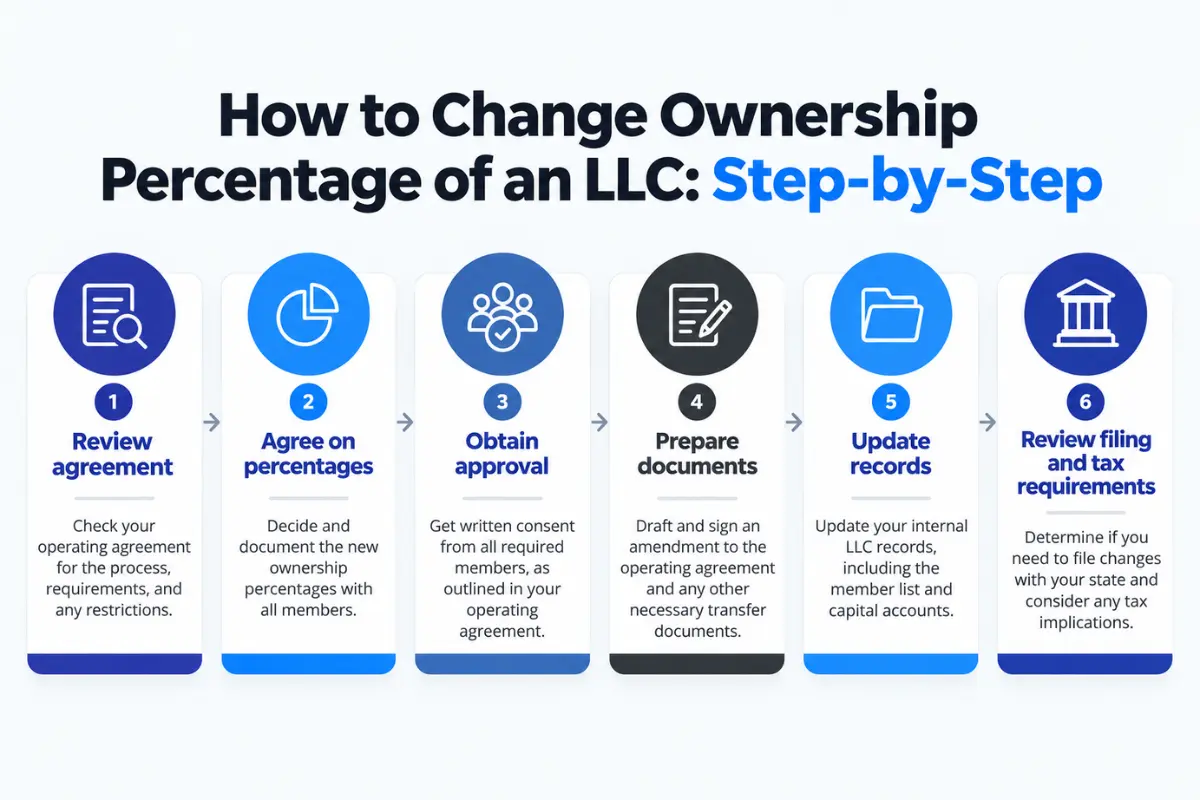
How to Change Ownership Percentage of an LLC: Step-by-Step
1. Review Your LLC Operating Agreement
Your operating agreement is the first place to look. Most agreements cover ownership transfers, how new members are admitted, voting requirements, and what approvals a change needs. Some restrict transfers altogether or require unanimous consent. Others only need a simple majority.
As the U.S. Small Business Administration explains, an operating agreement can address the percentage of members’ ownership as well as buyout and buy-sell rules.
If your agreement does not cover ownership changes, or your LLC never adopted one, your state’s default rules will fill the gap, and those are rarely as flexible as a custom agreement. This operating agreement guide breaks down what a strong agreement should include and how it should address ownership changes.
2. Agree on the New Ownership Percentages
Once you know what your agreement allows, the members involved need to agree on the new split and when it takes effect, including whether the change is a sale, a gift, or a new capital contribution. This affects how the change is documented and how voting power, profits, and distributions shift going forward.
If the change involves welcoming someone new rather than reshuffling percentages among current owners, our guide on how to add a member to an LLC covers that separately.
3. Obtain Required Member Approval
Follow whatever approval process your operating agreement and state law require, whether that is a simple vote or written consent from every member. Even when not strictly required, we recommend documenting the decision through a signed consent form or meeting minutes, creating a paper trail that protects everyone involved.
4. Prepare the Ownership Transfer Documents
With approval in hand, put the transaction in writing through a purchase agreement, sale agreement, or another transfer document, depending on whether money is changing hands or the interest is being gifted. A complete document should name the parties, describe the interest being transferred, note any consideration paid, and state the effective date. A generic template found online may not fit your operating agreement or state, so have it reviewed before anyone signs.
5. Amend the Operating Agreement and Ownership Records
Once the transfer is complete, update your operating agreement and ownership schedule to reflect the new percentages, along with any provisions tied to voting rights, profit allocation, or management responsibilities that changed. Keep signed copies of the amended agreement with your LLC’s permanent records so ownership stays easy to confirm later.
6. Review State Filing and Tax Requirements
Depending on your state, an ownership change may need an amendment, may show up on your next annual report, or may require no filing at all. Consider too whether the change affects your LLC’s tax classification, since moving from a single-member to a multi-member LLC changes how the business is taxed. When a transaction carries real tax or legal weight, consult a qualified professional before finalizing anything.
How to Divide Ownership of an LLC
There is no single formula for dividing ownership among LLC members. Some split it equally, while others base it on cash, property, or labor contributed, along with each person’s ongoing responsibilities.
Equal splits are simple, but not always fair. If one partner put up most of the startup capital while another handles daily operations, an equal split might not reflect what each person is bringing to the table. Unequal splits let members negotiate a structure that better matches their contributions.
Ownership percentage also does not automatically dictate every voting or distribution right. Members can agree, in the operating agreement, to separate financial ownership from control. Here is a simple example of a negotiated change:
| Member | Before | After |
|---|---|---|
| Member A | 50% | 60% |
| Member B | 50% | 40% |
| Total | 100% | 100% |
This shows a negotiated shift from an equal split to an unequal one. It is not a required formula. Your own numbers depend entirely on what your members agree to.
What Documents Are Needed to Change LLC Ownership?
LLC Ownership Percentage Document
In most LLCs, the operating agreement and its ownership schedule are the primary documents recording each member’s interest. When ownership changes, that schedule needs updating alongside any formal amendments and written consents approving the change, so the LLC’s records stay accurate. If your LLC does not have one in place yet, this walkthrough on creating an operating agreement can help you get started.
LLC Transfer of Ownership Form
A transfer agreement commonly documents the sale or assignment of an ownership interest to an existing or new member. There is no single universal LLC transfer of ownership form that fits every business or state, so a document tailored to your operating agreement holds up better than a generic template. Transferring an economic interest, meaning the right to receive profits, also does not always come with full membership or management rights. Many operating agreements separate these, so a buyer may need separate approval before becoming a full voting member.
Do You Need to File an Ownership Change With the State?
This depends on your state and the type of change involved. Requirements are not the same everywhere, so what applies in one state may not apply in another.
It helps to separate internal ownership records from anything filed publicly with the Secretary of State. Internal records, like your operating agreement and ownership schedule, stay with your company. Some states expect changes to show up on an amendment or the next annual report, which is a good place to start if you are unsure what your state requires.
Not every ownership percentage change requires a brand new formation filing. Many changes are handled entirely through internal documentation, with any state filing coming later through routine compliance updates.
How Does Changing LLC Ownership Affect Taxes?
Tax consequences depend heavily on the transaction and how your LLC is currently taxed. Selling an interest may trigger capital gains taxes for the seller, and adding or removing members can change how income and losses are allocated among the remaining owners.
One change worth flagging is moving between a single-member LLC and a multi-member LLC, which shifts how the IRS treats your business, from a disregarded entity to a partnership, or the reverse if a member leaves and one owner remains. Because these changes affect reporting and how profits are allocated, talk with a tax professional before finalizing any transfer with real financial weight behind it.
Common Mistakes to Avoid When Changing LLC Ownership
- Changing percentages without first reviewing the operating agreement.
- Failing to obtain the member approval required by the agreement or state law.
- Using an incomplete or generic transfer document that does not fit the transaction.
- Forgetting to update the operating agreement and ownership records after the change.
- Assuming a transfer automatically grants full management or voting rights.
- Overlooking state filing or tax requirements tied to the change.
Conclusion
Changing an LLC’s ownership percentage is rarely as simple as agreeing on new numbers. Following your operating agreement, documenting the transaction properly, and updating your company’s records matter just as much as the split itself, and state requirements and tax consequences deserve a close look before anything is finalized.
Need Help Updating Your LLC Ownership?
Changing ownership percentages can mean updating your operating agreement, documenting the transfer, and completing whatever state filings apply, which is a lot to track at once.
We help business owners manage the filing and compliance side of running an LLC, including annual reports and registered agent service. We are not a law firm and cannot provide legal advice, but our compliance support can help take some of the paperwork off your plate. Contact us to talk through your LLC’s filing and compliance needs.
FAQs
Generally, yes. As long as the change follows your operating agreement and applicable state law, LLC owners can adjust ownership percentages between existing members or bring in new ones.
The process typically involves reviewing your operating agreement, getting approval from the required members, documenting the transfer in writing, updating your records, and checking whether any state filings apply.
A written transfer agreement is often a good idea, but the documentation you need depends on the transaction and your state. There is no single form that fits every LLC.
Not automatically. Simply adjusting percentages usually does not require a new Employer Identification Number from the Internal Revenue Service. Certain changes, such as shifting from a single-member to a multi-member LLC or changing the LLC's responsible party, may create different requirements, so confirm with a tax professional if your situation is more than a straightforward adjustment.
Yes. Members can agree to unequal interests based on contributions, responsibilities, or negotiated terms, as long as the arrangement is clearly documented in the operating agreement.
Yes. Updating the agreement and ownership schedule keeps your company's records accurate and helps prevent confusion or disputes about who owns what down the road.
Disclaimer: This content is intended for general educational and informational purposes only and does not constitute legal, tax, or accounting advice. Every effort is made to keep the information current and accurate; however, laws, regulations, and guidance can change, and no representation or warranty is given that the content is complete, up to date, or suitable for any particular situation. You should not rely on this material as a substitute for advice from a qualified professional who can consider your specific facts and objectives before you make decisions or take action.