

How to Create an Operating Agreement for an LLC
What happens when two business partners disagree and neither one can prove what was actually agreed to? For a lot of LLC owners, the answer is expensive legal fees, damaged relationships, and sometimes a business that never recovers.
The good news is that one document can prevent nearly all of it: the operating agreement. Whether you are forming a single-member LLC or bringing on business partners, this agreement sets the rules your company will run by, long before any disagreement ever has the chance to start.
This document matters just as much as filing your formation paperwork. DoMyLLC helps new business owners put these agreements together every day, and this guide will walk you through the process step by step.

Key Takeaways
- An LLC operating agreement sets the ground rules for ownership, management, voting, distributions, and other internal matters.
- Your agreement should reflect your LLC’s actual ownership and management setup, not just copy another company’s document.
- Single-member and multi-member LLCs need to think about different issues when writing their agreements.
- State laws on operating agreements vary, so it matters where your LLC was formed.
- Free templates can give you a starting point, but they may not fit every LLC’s situation.
What Is an LLC Operating Agreement?
An LLC operating agreement is a legal document that spells out how your limited liability company operates. Think of it as your company’s internal rulebook. It covers who owns the business, how decisions get made, and what happens if something changes down the road.
A well drafted operating agreement can address:
- LLC ownership
- Member rights and responsibilities
- Management structure
- Voting and decision-making
- Profit and loss allocations
- Distributions
- Adding or removing members
- Ownership transfers
- Dissolution
This is different from your Articles of Organization, which you file with the state to legally create your LLC. Your operating agreement stays with your business as an internal document, and most states do not require you to file it anywhere.
According to Cornell Law School’s Legal Information Institute, “An operating agreement is the governing contract adopted by members of a Limited Liability Company (LLC).”
In other words, an operating agreement is more than a basic formation document. It creates contractual rules that govern the relationship between your LLC and its members, covering everything from day to day operations to what happens years down the line.
If you want a deeper look at how this document works, our guide on the LLC operating agreement covers it in more detail.
Do All LLCs Need an Operating Agreement?
Not every state legally requires an operating agreement, but that does not mean you should skip one. Some states specifically require LLCs to have a written operating agreement, while others leave it up to the business owner.
Five states, California, Delaware, Maine, Missouri, and New York, require LLCs to have an operating agreement or comparable LLC agreement. Only New York requires the agreement to be written and allows members up to 90 days after filing the Articles of Organization to adopt it. California, Delaware, Maine, and Missouri generally allow written, oral, or implied agreements; Delaware and Maine use the term “limited liability company agreement.”
LLC laws are not identical from state to state. The rules that apply to your business depend partly on the state where you formed your LLC, so it is worth checking your state’s specific requirements before deciding to skip this step. Even where an operating agreement is not legally required, having one still protects your personal assets and keeps your business running smoothly.
How to Create an Operating Agreement Step by Step
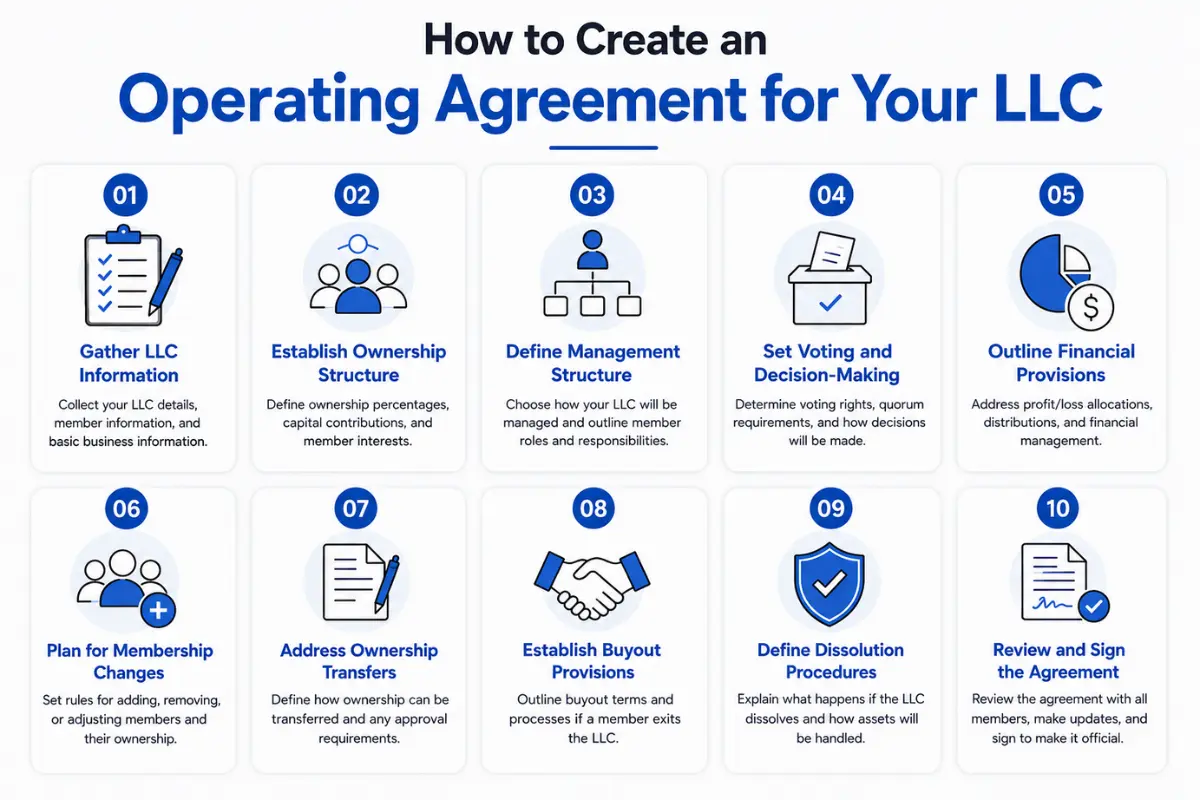
To create an LLC operating agreement, gather your business and ownership information, establish your LLC’s ownership and management structure, define voting and financial rules, set procedures for membership and ownership changes, address dissolution, and have all members review and sign the completed agreement.
Let’s break each of these steps down.
Step 1: Gather Your LLC Information
Before you start writing, collect the basic details about your business:
- Legal LLC name
- Principal business address
- State of formation
- Formation date
- Registered agent information
- Member names
- Ownership percentages
Your agreement should reflect your LLC’s current business and ownership information. Double check these details against your Articles of Organization so everything lines up.
Step 2: Define LLC Ownership
Next, determine and document:
- LLC members
- Ownership percentages
- Initial capital contributions
- Additional contribution requirements, if any
- Ownership interests
Clear ownership information matters for every LLC, but it becomes especially important with more than one member. Vague ownership terms are a common source of disputes down the road.
Step 3: Choose a Management Structure
LLCs generally use one of two management structures:
- Member-managed LLC: Members participate directly in running the business.
- Manager-managed LLC: One or more designated managers handle day to day management responsibilities.
Your agreement should clearly document which structure your LLC uses and who holds that authority. Without this, members and outside parties may not know who can actually make decisions for the company. For a closer look at the differences, see our comparison of member-managed vs. manager-managed LLC options.
Step 4: Establish Member and Manager Roles
Once you know your management structure, spell out specific roles:
- Member responsibilities
- Manager responsibilities
- Contracting authority
- Banking authority
- Recordkeeping responsibilities
- Limits on individual authority
Clearly defined authority matters most once your LLC has multiple owners. It keeps members from overstepping their role and gives everyone a clear reference point later.
Step 5: Establish Voting and Decision-Making Rules
Your operating agreement should cover:
- Voting rights
- Voting percentages
- Majority approval
- Supermajority approval
- Unanimous approval
- Decisions requiring member votes
- Meetings
- Written consent
Imagine a 50/50 LLC where two members disagree on a major decision. Without clear voting rules, that disagreement can turn into a deadlock that stalls the business. A well drafted operating agreement should include a plan for breaking ties before they ever happen.
Step 6: Determine How Profits, Losses, and Distributions Are Handled
This section should cover:
- Allocation of profits and losses
- Cash distributions
- Distribution timing
- Ownership percentages
- Tax considerations
Profit and loss distribution methods do not always have to match ownership percentages exactly, though many LLCs choose to keep them aligned for simplicity. Because financial arrangements can get complicated fast, LLC owners often want professional tax or legal guidance when setting up anything beyond a straightforward split. DoMyLLC does not provide tax advice, so we always recommend working with a CPA or tax professional for this part.
Step 7: Establish Rules for Adding or Removing LLC Members
Membership changes should be addressed ahead of time, including:
- Adding members
- Member approval
- New member contributions
- Voluntary withdrawal
- Death or incapacity
- Member buyouts
- Changes in membership
Life happens, and businesses change. Having these rules in place before they are needed helps avoid confusion or conflict later. Learn more in our guide on how to add a member to an LLC.
Step 8: Establish Rules for Ownership Transfers
Your agreement can also address what happens if a member wants to sell or transfer some or all of their LLC interest, including:
- Transfer restrictions
- Approval requirements
- Rights of existing members
- Buyout procedures
- Business valuation procedures
- What happens to voting and economic rights after a transfer
These provisions protect remaining members from unexpected ownership changes and give everyone a clear process to follow.
Step 9: Establish Procedures for Dissolving the LLC
Even if you never plan to close your business, your agreement should still address:
- Events triggering dissolution
- Required member approval
- Winding up the business
- Paying LLC liabilities
- Distribution of remaining assets
- Responsibilities during dissolution
Dissolution procedures specify how and when an LLC can be closed, which gives members a clear roadmap if that day ever comes.
Step 10: Review, Sign, and Store the Operating Agreement
Once your agreement is drafted:
- Have all members review it carefully
- Obtain required signatures
- Establish an effective date
- Give each member a copy
- Store the agreement with your LLC’s important business records
- Review the agreement whenever significant business changes occur
Members must sign the operating agreement to make it legally binding, so do not skip this final step even if everything feels informal among your members.
What Should an LLC Operating Agreement Include?
Here is a quick checklist of what most operating agreements address:
- LLC name and business information
- Members and ownership percentages
- Capital contributions
- Management structure
- Member and manager authority
- Voting procedures
- Profit and loss allocations
- Distribution procedures
- Adding and removing members
- Ownership transfers
- Buyout procedures
- Dissolution
- Amendment procedures
- Signatures
The IRS notes that “provisions for operating agreements vary widely according to state law.”
There is no single operating agreement format that works for every LLC. Your provisions should reflect your business’s actual circumstances while still complying with the laws of your state.
Single-Member vs. Multi-Member Operating Agreements
How you write an operating agreement can differ depending on how many owners your LLC has. Our guide to Single-Member vs. Multi-Member LLCs explains the key differences between these ownership structures.
Single-Member LLC Operating Agreement
Even with just one owner, an operating agreement still serves a purpose. It can address:
- Sole ownership
- Management authority
- Owner contributions
- Decision-making authority
- Business continuity
- LLC records
Single-member LLCs benefit from an operating agreement because it reinforces your limited liability protection. It shows your LLC operates as a separate entity from you personally.
Multi-Member LLC Operating Agreement
With more than one owner, your agreement generally needs to cover more ground, including:
- Ownership percentages
- Capital contributions
- Voting rights
- Member responsibilities
- Profit distributions
- Member departures
- Ownership transfers
- Buyouts
- Dispute procedures
Multi-member agreements need to cover more situations simply because more relationships are involved. The more owners you have, the more value a detailed agreement provides.
Can You Write Your Own Operating Agreement?
Yes, in most cases an LLC owner can write their own operating agreement, depending on the laws in their state and how complex their LLC’s situation is.
That said, professional help may be worth considering if your LLC involves:
- Multiple members
- Unequal ownership percentages
- Different voting rights
- Significant capital contributions
- Complex distribution arrangements
- Investors
- Buy-sell provisions
- Planned ownership transfers
Simple, single-member LLCs can often handle this on their own. Once your situation gets more complicated, a second set of experienced eyes helps you avoid costly mistakes.
Can You Use a Free LLC Operating Agreement Template?
A free operating agreement template can give you a helpful starting framework, but treat it as a starting point rather than a finished agreement. Generic templates are not written with your specific LLC in mind.
Common issues with free templates include:
- Not accounting for state specific law
- Missing important provisions
- Incorrect management structure
- Inappropriate voting rules
- Failure to address ownership changes
- Provisions that do not reflect how the business actually operates
Templates work best as a rough outline you customize, not a document you fill in and forget about. If you would rather skip the guesswork, working with a professional service to prepare your operating agreement helps make sure nothing important gets missed.
Operating Agreement Example
Rather than reproducing a full template, here is a short hypothetical example to illustrate how an operating agreement might work.
ABC Consulting LLC has three members:
- Member A, 50 percent ownership
- Member B, 30 percent ownership
- Member C, 20 percent ownership
Their operating agreement might require votes proportional to ownership percentage, meaning Member A alone cannot approve major changes without another member’s support. It could also outline each member’s initial capital contribution, set distribution percentages that match ownership, and designate the LLC as member-managed.
This is only an illustrative example, not a ready-to-use legal provision or agreement. Your own operating agreement should reflect your LLC’s actual ownership, contributions, and management preferences.
Common Mistakes to Avoid When Writing an Operating Agreement
When learning how to write an operating agreement, watch out for these common mistakes:
- Copying another company’s agreement
- Using a generic template without customizing it
- Leaving ownership percentages unclear
- Failing to establish voting procedures
- Not addressing member departures
- Ignoring ownership transfers
- Failing to establish amendment procedures
- Using provisions inconsistent with actual business practices
- Failing to update the agreement over time
Any one of these mistakes can lead to confusion or disputes later. Taking the time to get it right upfront saves headaches down the road.
When Should You Update an LLC Operating Agreement?
Your operating agreement is not a set it and forget it document. Revisit it whenever significant changes occur, such as:
- Adding a member
- Removing a member
- Changing ownership percentages
- Changing management structure
- Changing voting rights
- Significant new capital contributions
- Changing member responsibilities
- Changing distribution arrangements
- Adding buyout provisions
Amendment processes outline how changes can be made to the operating agreement, so build a simple amendment procedure into your original document. That way updates do not require starting from scratch.
Conclusion
A solid operating agreement protects your personal assets, clarifies how your business runs, and helps prevent costly disputes between members. Whether you are just forming your LLC or realizing you never got around to writing one, it is a document worth prioritizing.
How DoMyLLC Simplifies Creating an Operating Agreement
Not every business owner wants to rely solely on a generic template. If that sounds like you, we can help.
We include a free sample operating agreement with every LLC formation package, giving you a starting point tailored to your new business. If you would rather not fill it out yourself, we also offer an operating agreement service for $99, where our team fills in the blanks for you based on your business details.
Whether you need help forming your LLC, setting up registered agent service, filing annual reports, or getting your operating agreement squared away, we are here to help you get it right the first time. Contact Us to get started.
How to Create an Operating Agreement FAQs
Gather your LLC information, establish ownership, select a management structure, set voting and financial rules, address membership changes, establish dissolution procedures, then review and sign the final agreement.
Free templates are available and can work for simple, single-member LLCs. Just make sure to customize the template to match your business and your state's requirements rather than using it as is.
Yes, in many cases you can write your own operating agreement, especially for a straightforward, single-member LLC. More complicated ownership or financial arrangements may benefit from professional assistance.
It depends on your state. A handful of states legally require a written operating agreement, while others do not. Even where it is not required, having one still helps protect your personal assets and clarify how your business runs.
A typical operating agreement outlines ownership percentages, management structure, voting rights, capital contributions, and distribution rules. See the ABC Consulting LLC example earlier in this article for an illustration.
Notarization requirements are not the same everywhere. Check your specific state's rules before finalizing your agreement, since some states may have additional requirements.
Most states do not require you to file your operating agreement anywhere. It stays with your business records as an internal document, though it is still worth verifying your state's specific requirements.
Disclaimer: This content is intended for general educational and informational purposes only and does not constitute legal, tax, or accounting advice. Every effort is made to keep the information current and accurate; however, laws, regulations, and guidance can change, and no representation or warranty is given that the content is complete, up to date, or suitable for any particular situation. You should not rely on this material as a substitute for advice from a qualified professional who can consider your specific facts and objectives before you make decisions or take action.